The Benefits, Applications, and How It Works
Manufacturing investment castings requires a team with a deep working knowledge of a wide range of alloys, which our customers need to produce their products across a broad range of end-use applications.
While the greatest tonnage of alloys cast would be considered “standard” alloys such as carbon steel, alloy steel, stainless steel, and some nickel-based alloys such as Inconel, Hastelloy, and Monel, there also remains the need for a highly valuable and versatile family of copper-based alloys that are known as brasses and bronzes.
What are Copper-Based Alloys?
The family of cast copper-based alloys have an extremely broad range of applications and advantages over iron, iron-based “steels” and derivatives, and other alloys. The family of copper-based alloys is classified as “non-ferrous,” meaning they are not based on an alloy that starts with iron as its base metal.
While pure copper has a wide range of applications in industry, primarily due to its excellent electrical properties and superior corrosion resistance, especially in water, the pure alloy can be significantly strengthened and made more useful by combining it with other alloying elements.
When copper is primarily alloyed with zinc, the alloy is called brass.
When copper is primarily alloyed with tin, the alloy is known as bronze.
Within the sub-groups of brass and bronze, there are many different varieties of these common alloy families; some, including pure copper, do not lend themselves as well to being able to be melted and poured into molds in a normal atmosphere as others, so there are limitations on which of the brass and bronze alloys can be produced as castings. That said, almost every market we serve has applications where cast copper-based alloys shine.
What are the Benefits of Casting Copper-Based Alloys?
Pure copper is soft and ductile and therefore finds its greatest applications where its superior electrical conductivity and corrosion resistance can be utilized. Pure copper is rarely cast. However, by alloying copper with several other elements, the resulting alloy is now castable and can be as strong as tempered steel, allowing it to find many more suitable casting applications.
Cast copper alloys have an extremely broad range of applications. They are used in virtually every industrial component, device, or machinery, from plumbing goods to electronic components to marine and nuclear equipment. Their favorable properties are often specified for applications due to multiple combinations of advantages. This is particularly valuable when a product must satisfy several requirements simultaneously.
The following properties list some of the reasons investment-cast copper alloys are advantageous in many settings:
Excellent Corrosion Resistance
The ability to withstand corrosive environments is the most important and best-known characteristic of cast copper alloys. The alloys have a natural corrosion resistance, making them durable without the need for constant maintenance, which is an appealing characteristic for cost-effectiveness.
Water-handling and processing equipment is one of casting’s greatest single markets, as well as being found in applications involving corrosive industrial and process chemicals. Finally, they are extremely popular for use in the food and beverage industries, including dairy equipment castings.
Favorable Mechanical Properties
Pure copper is soft and ductile, and it is understandably used more often for its high conductivity than for its mechanical strength. Some cast copper alloys, on the other hand, have strengths that rival steel. Almost all copper alloys retain their mechanical properties, including impact toughness. at very low temperatures.
Other alloys are used routinely at temperatures as high as 800 F (425 C). No class of engineering materials can match the combination of strength, corrosion resistance, and thermal and electrical conductivity of copper alloys over such a broad temperature range.
Friction and Wear Properties
Cast sleeve bearings are an important application for copper alloys. For sleeve bearings, no material of comparable strength can match high leaded bronzes in terms of low wear rates against steel. For worm gears, nickel bronzes and tin bronzes are industry standards. Equally important, the copper alloys’ broad range of mechanical properties enables the designer to match a specific alloy with a bearing’s precise operating requirements.
Biofouling Resistance
Copper effectively inhibits the attachment of algae, barnacles, and other marine organisms to submerged surfaces. Non-fouling properties are strong in the cast copper alloys used in marine service. Products such as seawater piping, fittings, and pumps and valves made from copper alloys therefore remain free from biomass buildup and are able to operate continuously without the periodic cleanup needed with steel, rubber or fibre-reinforced plastic products.
High Electrical and Thermal Conductivity
Copper’s electrical and thermal conductivities are higher than those of any other metal except silver. Even copper alloys with relatively low conductivities compared with pure copper conduct heat and electricity far better than other structural metals such as stainless steels and titanium. Unlike most other metals, the thermal conductivity of many copper casting alloys increases with rising temperature.
Which Specific Copper Based Alloys Can Best Be Cast?
Many copper based alloys can be investment cast successfully. Here’s a list of the most popular copper alloy brasses and bronzes which Niagara Investment Castings produces. This and a full list of the other metal alloys NIC produces can be found at this link.
Specification |
Cast Grade |
Wrought Equivalent |
| CDA 83400 | ALLOY 90/10 | RED BRASS |
| CDA 92200 | ALLOY A | LEADED TIN BRONZE |
| CDA 83600 | ALLOY B | LEADED RED BRASS |
| CDA 84400 | ALLOY C | SEMI-RED BRASS |
| CDA 95400 | ALBR9C | ALUMINUM BRONZE |
| CDA 86500 | MB65M | MANGANESE BRONZE |
| CDA 90300 | SAE 620 | TIN BRONZE |
| CDA 93200 | SAE 660 | HIGH LEADED TIN BRONZE |
| CDA 87300 | EVERDUR | SILICON ALLOY |
| CDA 87200 | SB12A | SILICON BRONZE |
| CDA 87500 | SB875 | SILICON BRASS |
| CDA 95800 | C95800 B271, B148 | NICKEL AL-BRONZE |
Which Parts Can Be Cast in Copper Based Alloys?
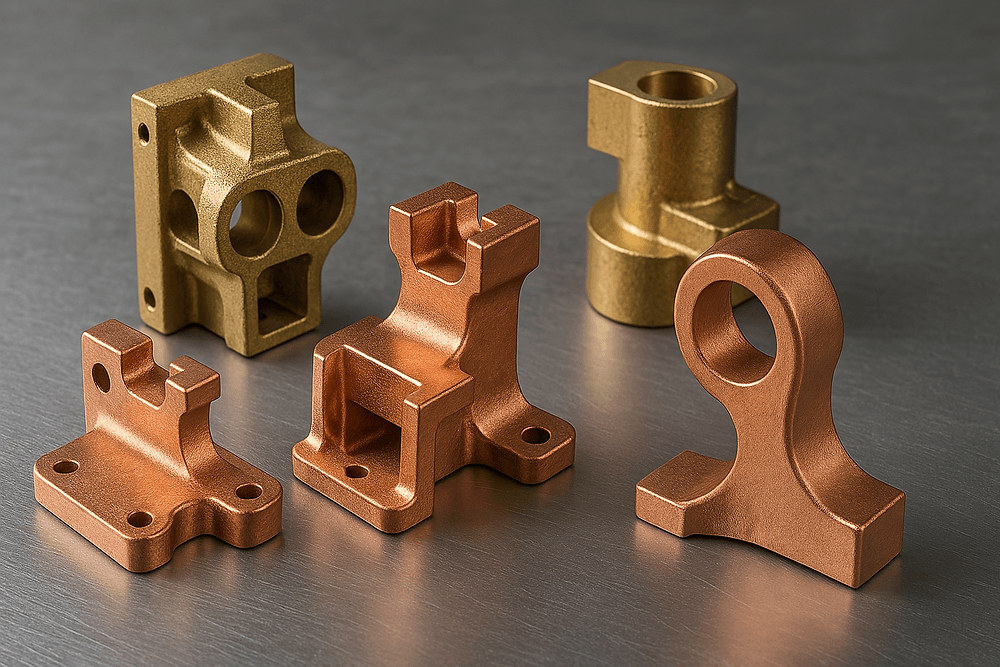
The family of parts that can be successfully cast in the wide range of copper based alloys is unlimited. While investment castings often offer the mechanical designers unlimited freedom of design within the capabilities of the investment casting process, the only difference between the ferrous alloys and copper alloys is that the copper alloys are softer and can be damaged by the mechanical removal of ceramic materials from the castings after manufacturing is complete, especially ceramic cores that are used to cast internal details.
This must be considered because the technique of dissolving ceramic cores with molten salt etchant that is used with removing inaccessible ceramic in ferrous castings, cannot be done with copper based alloys as the etchant will attack the base metal.
Other than this, copper based investment castings are designed using the same design guidance as any other material, including shrinkage considerations and other general foundry guidelines.
Choose Niagara Investment Castings for Your Investment Casting Requirements
Staying competitive in a global market requires more than just standard solutions. It demands resourcefulness. At Niagara Investment Castings, that mindset drives our team to deliver precision and value in every project.
We invite you to see how investment casting can future-proof your components. Contact us today to find the ideal alloy for your application, including our high-performance copper-based options.