One of the most underappreciated families of stainless steel is the family known as “duplex stainless steels”, which is incredible considering the multitude of advantages over typical austenitic stainless steels, which are far more commonly used throughout industry. But just what exactly are duplex stainless steels, and why should every engineer know about them?
What is Duplex Stainless Steel?
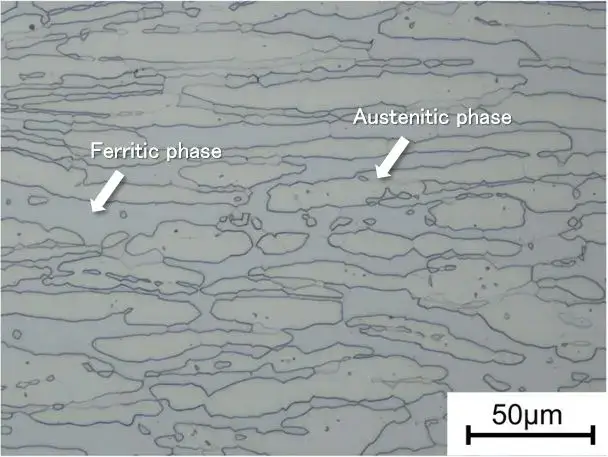
 The reason this family of stainless steel are called “duplex” is primarily due to the fact that their metallurgical structure consists of two phases, austenite (face-centered cubic lattice) and ferrite (body centered cubic lattice) in roughly equal proportions. This approximately 50-50 “balance” of these two phases is a result of the careful mixing of alloying elements, primarily chromium, molybdenum, tungsten, and silicon to promote the ferrite in the mix, and nickel, manganese, carbon, and nitrogen to support the austenite in the alloy.
They provide better corrosion resistance, particularly to chloride stress corrosion and pitting, and higher strength than standard austenitic stainless steels, such as the commonly used 300 series alloys. Duplex stainless steels are also sometimes selected for their high mechanical properties. They are highly conducive to investment casting and especially useful for corrosion situations where stress corrosion cracking is a concern.
What is Super Duplex Stainless Steel?
The family of duplex stainless steels, classified as “Super Duplex” alloys, is a unique group developed on the same basis as regular duplex stainless steels; they were designed to meet the specific demands of the oil and gas and chemical processing industries. Super duplex stainless steels are high-performance alloys with approximately 25% chromium content and a mixed austenitic and ferritic microstructure, enhancing strength and corrosion resistance.
They offer a superior corrosion resistance and strength to standard duplex alloys; they are more difficult to process because the higher contents of chromium, as well as generally higher amounts of molybdenum, nitrogen, and tungsten promote the formation of intermetallic phases, which reduce the impact resistance of the specialty alloy.
Duplex Stainless Steel Applications
The most useful properties of duplex stainless steels over standard stainless steels include the following :
-
Twice the design strength of austenitic and ferritic stainless steels
-
Wide range of corrosion resistance to match the application
-
Good toughness down to minus 80 deg. C
-
Particular resistance to stress corrosion cracking
-
Weldable – Not as straightforward as austenitic alloys, but much better than ferritic alloys.
Standard austenitic steels, such as 304 and 316, are the most susceptible to stress corrosion cracking. Duplex stainless steels offer an improvement over these standard alloys.
With these properties taken into consideration, it is easy to see why duplex stainless steels find significant applications in the following industries and products :
-
Pressure vessels
-
Storage tanks
-
Hot water tanks
-
Brewing tanks, pumps, and valves
-
Swimming pool parts (chlorine environments)
-
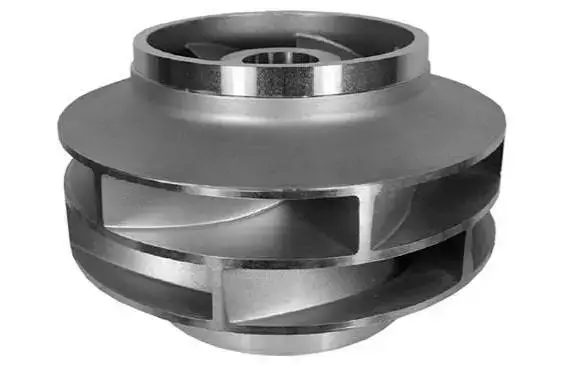
Heavy-duty pump impellers
Is Duplex Stainless Steel Magnetic?
When it comes to stainless steel and magnetism, there is no greater misconception than whether stainless steel is magnetic. Many people believe that if they test a casting with a magnet and it is magnetic, the casting MUST be steel, not stainless steel. Nothing could be further from the truth.
There is a very distinct magnetic property when the two main phases of austenite and ferrite are examined. The “austenite” phase of steel is not magnetic, so any stainless steel that is 100% austenitic is therefore NOT magnetic. These alloys are generally a “wrought” version of a 300-series stainless steel. However, the “ferrite” phase of steel IS MAGNETIC.
An alloy which contains even a small amount of ferrite in the microstructure will show signs of magnetism, from weak at low levels of ferrite, up to extremely strong magnetism as the ferrite level increases. This is where the confusion lies, since almost every cast stainless steel, even the austenitic alloys such as the 300 series, will show some signs of magnetism, as these alloys are “balanced” to contain some ferrite for castability.
Taking this into consideration, with approximately 50% of the alloy consisting of the ferrite phase, all duplex stainless steels are strongly magnetic.
Is Duplex Stainless Steel Austenitic?
The question of whether duplex stainless steels are considered austenitic is fair, as they exhibit many traits similar to those of austenitic stainless steels. However, the fact that the alloy contains roughly equal proportions of austenite and ferrite gives it distinct characteristics, including increased corrosion resistance and strength, compared with typical austenitic stainless steel grades. It should also be noted that until a proper solution anneal heat treatment is applied to the casting, the alloy is not considered to be able to offer its greatest potential of these two characteristics.
Duplex Stainless Steel Grades
Cast duplex stainless steel is divided into three categories, which group together the differentiating characteristics of each grouping.
Lean Duplex Stainless Steel
Designed as a cost-effective option by reducing the most expensive alloying elements like nickel while using nitrogen and manganese to maintain strength.
-
ASTM Grade: CD4MCuN
-
UNS Designation: J93243 / S32304
-
Key Characteristics: Provides approximately twice the yield strength of standard austenitic grades and excellent stress corrosion cracking (SCC) resistance.
Standard Duplex Stainless Steel
The most commonly specified group of duplex alloys, these alloy grades contain roughly 22% chromium and 3% molybdenum, delivering a suitable balance of overall corrosion resistance and mechanical strength.
-
ASTM Grade: CD3MN
-
UNS Designation: J92205 (corresponds to wrought 2205)
-
Key Characteristics: PREN of 34-36. Ideal for chemical processing, pulp and paper, and offshore oil/gas components.
Super Duplex Stainless Steel
Designed for the highest level of corrosion resistance in highly aggressive, chloride-rich environments like deepwater oil production and seawater desalination.
-
ASTM Grade: CE3MN, CD3MWCuN
-
UNS Designation: J93345 / S32750 (CE3MN), J93380 / S32760 (CD3MWCuN)
-
Key Characteristics: High PREN (≥ 40). Heavy amounts of chromium, molybdenum, and nitrogen result in outstanding resistance to pitting and crevice corrosion
Duplex Stainless Steel Castings: Advantages & Applications
Manufacturers typically call out duplex stainless steels when the combination of superior strength and corrosion resistance is paramount, and much of the duplex stainless steel used in manufacturing components is in the form of castings, especially investment castings. The duplex alloys are readily melted and poured in conventional melting furnaces without the need for special atmospheric controls during either process. Examples of the kinds of castings made from duplex stainless steel include :
-
Pump Impellers and Casings
-
Valve components
-
Parts used in seawater applications, such as marine vessels and components
-
Pulp and paper processing equipment
-
Pollution control components
-
Water and desalination components
-
Oil and gas industry components
Elevate Your Next Project: Partner with Niagara Investment Castings
In an industry where engineering demands are constantly rising, settling for standard 300-series stainless steels shouldn’t be your default. Duplex and super duplex alloys offer the ultimate “best of both worlds” solution, fusing the high yield strength of ferrite with the superior corrosion resistance of austenite.
However, fully unlocking the potential of these dual-phase alloys requires a manufacturing partner who truly understands their unique metallurgical balance, castability, and precise heat-treatment demands.
At Niagara Investment Castings, we don’t just pour metal; we engineer reliability. Whether you are designing high-performance pump impellers, critical valve components, or corrosion-resistant marine hardware, we have the specialized expertise to deliver high-quality, near-net-shape duplex castings tailored to your exact specifications.
Don’t let material fatigue or stress corrosion cracking hold your components back. Contact the expert team at Niagara Investment Castings today to discuss how we can bring your duplex stainless steel projects to life!