Manufacturing high-quality investment castings does not just happen by accident; in fact, some investment castings are so critical in their application that even good sound foundry practice and attention to even the most meticulous detail are often not enough to ensure the cast component will not fail in its role in the end product.
This is where radiography of investment castings proves its strength as one of the most important “Non Destructive Test” or NDT methods available today.
Even today, some designers are unsure whether investment castings are right for their application, due to concerns about whether the casting can be certified to meet the required quality level.
Radiography of investment castings is a critical testing method used to inspect internal, volumetric defects such as shrinkage, porosity, cracks, and inclusions. It uses X-rays or gamma rays to penetrate complex cast parts, ensuring structural integrity in high-specification industries such as nuclear, aerospace, pressure-retaining, and defence, where a flaw inside the casting could lead to failure of the investment casting in service.
Casting Radiography
Non-Destructive Testing (NDT) for castings involves evaluating metal parts for internal and surface defects, such as cracks, porosity, and inclusions, without damaging them, thereby ensuring structural integrity and compliance with quality standards. Key methods include magnetic particle, dye penetrant testing for surface issues, and ultrasonic testing.
However, one of the most impactful NDT tests for castings is radiography, or X-ray testing for internal flaws. This test is highly effective at identifying internal voids, inclusions, and shrinkage discontinuities caused by solidification issues.
Techniques
-
- Film Radiography: Produces a physical image for analysis.
- Digital Radiography: Allows for faster imaging and interpretation.
- Computed Tomography (CT): Provides 3D imaging for detailed analysis.
Sources
High-energy radiation is used, including X-ray machines or gamma ray sources like Iridium 192 (Ir-192) and Cobalt 60 (Co-60), which can penetrate thick, dense, or complex-shaped metals.
Steel Casting Radiography
Radiography of investment castings is a highly useful, cost-effective non-destructive testing method that enables casting foundries to conduct high-quality inspections and produce incredibly detailed images.
Investment casting enables businesses to produce intricate, high-quality parts with impressive surface finishes. This method also has several drawbacks. Since creating an investment involves many complex steps, there’s a high risk of defects in the moulding process. Many factors affect the quality of the investment mold and the casting, making quality challenging to uphold consistently. Therefore, your investment-cast products should undergo thorough inspections before they’re ready for use if the end-use application is critical, such as components used in pressure, nuclear, or high-stress applications.
Casting Radiography Levels
Radiographs are often compared to standards such as ASTM reference films to determine the severity of defects (e.g., classifying porosity levels).
Casting radiography levels, often defined by ASTM standards (E446, E186, E280), classify internal defects in casting parts based on severity, typically ranging from Level 1 (minor) to Level 5 (severe). These levels help determine acceptance, where level 1 is generally the highest quality (least defects), and level 5 is the lowest.
Key Radiography Standards for Castings
ASTM E446
Standard Reference Radiographs for Steel Castings Up to 2 inches.
ASTM E186
Standard Reference Radiographs for Heavy-Walled (2 to 4 inches) Steel Castings.
ASTM E280
Standard Reference Radiographs for Heavy-Walled (4 to 12 inches) Steel Castings.
ISO4993
Radiography of steel and iron castings.
Casting Radiography Defects
The severity levels are based on the degree of discontinuities, with 1 being the least severe and 5 the most severe:
Gas porosity or blow holes
are caused by accumulated gas or air which is trapped by the metal. These discontinuities are usually smooth-walled rounded cavities of a spherical, elongated or flattened shape. If the sprue is not high enough to provide the necessary heat transfer needed to force the gas or air out of the mold, the gas or air will be trapped as the molten metal begins to solidify. Blows can also be caused by ceramic molds that have a low permeability so that gas cannot escape.
Ceramic inclusions and dross
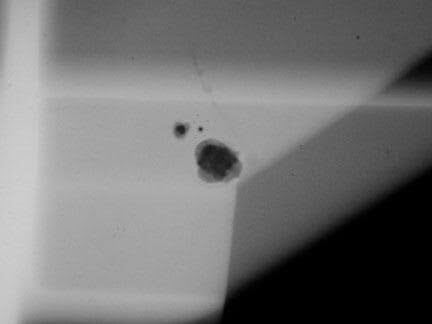
Ceramic inclusions and dross are nonmetallic oxides, which appear on the radiograph as irregular, dark blotches. These come from disintegrated portions of mold or core walls and/or from oxides (formed in the melt) which have not been skimmed off prior to the introduction of the metal into the mold gates. Careful control of the melt, proper holding time in the ladle and skimming of the melt during pouring will minimize or obviate this source of trouble.
Shrinkage
Shrinkage is a form of discontinuity that appears as dark spots on the radiograph. Shrinkage assumes various forms, but in all cases it occurs because molten metal shrinks as it solidifies, in all portions of the final casting. Shrinkage is avoided by making sure that the volume of the casting is adequately fed by gating and a properly sized sprue which sacrificially retain the shrinkage.
Shrinkage in its various forms can be recognized by a number of characteristics on radiographs. There are at least four types of shrinkage: (1) cavity; (2) dendritic; (3) filamentary; and (4) sponge types. Some documents designate these types by numbers, without actual names, to avoid possible misunderstanding.
Cavity shrinkage
- Appears as areas with distinct jagged boundaries. It may be produced when metal solidifies between two original streams of melt coming from opposite directions to join a common front.
- Cavity shrinkage usually occurs at a time when the melt has almost reached solidification temperature, and there is no source of supplementary liquid to feed possible cavities.
Dendritic shrinkage
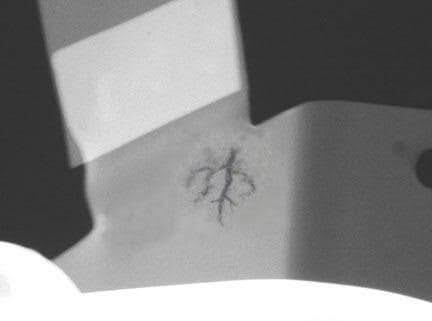
- A distribution of very fine lines or small elongated cavities that may vary in density and are usually unconnected.
Filamentary shrinkage
- Usually occurs as a continuous structure of connected lines or branches of variable length, width and density, or occasionally as a network.
Sponge shrinkage
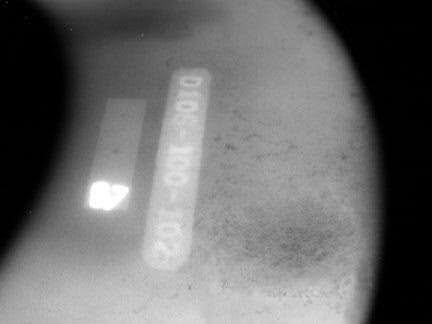
- Shows itself as areas of lacy texture with diffuse outlines, generally toward the mid-thickness of heavier casting sections. Sponge shrinkage may be dendritic or filamentary shrinkage. Filamentary sponge shrinkage appears more blurred because it is projected through the relatively thick coating between the discontinuities and the film surface.
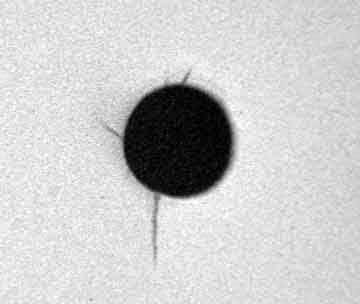
Cracks
Cracks are thin (straight or jagged) linearly disposed discontinuities that occur after the melt has solidified. They generally appear singly and originate at casting surfaces.
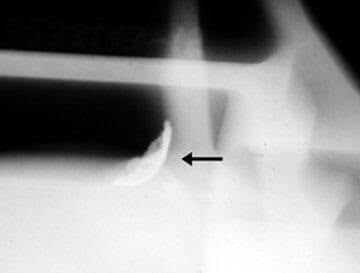
Cold shuts
These generally appear on or near the surface of cast metal as a result of two streams of liquid meeting and failing to unite. They may appear on a radiograph as cracks or seams with smooth or rounded edges.
Inclusions
Inclusions are non-metallic materials in an otherwise solid metallic matrix. They may be less or more dense than the matrix alloy and will appear on the radiograph, respectively, as darker or lighter indications.
Core shift
This appears as a variation in section thickness, usually on radiographic views, representing diametrically opposite portions of a cylindrical casting.
Hot tears
Hot tears are linearly disposed indications that represent fractures formed in a metal during solidification because of hindered contraction. The latter may occur due to overly hard (completely unyielding) mold or core walls. The effect of hot tears as a stress concentration is similar to that of an ordinary crack, and hot tears are usually systematic flaws. If flaws are identified as hot tears in larger runs of a casting type, explicit improvements in the casting technique will be required.
Misruns
Misruns appear on the radiograph as prominent dense areas of variable dimensions with a definite smooth outline. They are mostly random in occurrence and not readily eliminated by specific remedial actions in the process.
Mottling
Mottling is a radiographic indication that appears as an indistinct area of more or less dense images. The condition is a diffraction effect that occurs on relatively vague, thin-section radiographs, most often with austenitic stainless steel. Mottling is caused by interaction of the object’s grain boundary material with low-energy X-rays (300 kV or lower). Inexperienced interpreters may incorrectly consider mottling as indications of unacceptable casting flaws. Even experienced interpreters often have to check the condition by re-radiography from slightly different source-film angles. Shifts in mottling are then very pronounced, while true casting discontinuities change only slightly in appearance.
The History of Casting Radiography
Radiography of cast metal has changed little from the early days of its use. We still capture a shadow image of the sample with a detector opposite the x-ray source. The radiography process is usually done by a qualified lab that specializes in the service, having certified staff and modern xray equipment including all the necessary safety protocols in place.
Film is sometimes still used with procedures and processes technicians were using in the late 1800’s. Today, however, most radiography labs are able to generate images of higher quality and greater sensitivity through the use of higher quality films with a larger variety of film grain sizes. Most recently, digital array detectors have largely replaced film in many industries.
Casting Radiography Evolution through Automation
Film processing has evolved to an automated state, producing more consistent film quality by removing manual processing variables. Electronics and computers allow technicians to now capture images digitally. The use of “filmless radiography” provides a means of capturing an image, digitally enhancing, sending the image anywhere in the world, and archiving an image that will not deteriorate with time. Technological advances have provided industry with smaller, lighter, and very portable equipment that produce high quality X-rays.
While the process of radiography as a key method of NDT for investment castings has changed little, technology has evolved, allowing radiography to be widely used in numerous areas of inspection. Radiography has seen expanded usage in industry to inspect not only welds and castings, but to radiographically inspect items such as airbags and canned food products.
Gamma ray inspection has also changed considerably since the Curies’ discovery of radium. Man-made isotopes of today are far stronger and offer the technician a wide range of energy levels and half-lives. The technician can select Co-60 which will effectively penetrate very thick materials, or select a lower energy isotope, such as Tm-170, which can be used to inspect plastics and very thin or low density materials. Today gamma rays find wide application in industries such as petrochemical, casting, welding, and aerospace.
Casting Radiography Services: Choose Niagara Investment Castings
Manufacturing today requires resourceful out of the box thinking to stay competitive in a global market. This mindset drives the skilled team at Niagara Investment Castings to be the best at what we offer our clients. We are excited to work with you on all your investment casting requirements and to demonstrate that investing in YOUR components is a smart move today and into the future.
We are here to support you in getting started with the right investment castings and to demonstrate how radiography, as a highly effective NDT testing method, can be used in your particular application. Please simply contact us here to start the discussion.